Showing posts with label history. Show all posts

Friday, October 31, 2008

Happy Halloween: The Meaning of the Season


In a day filled with surprises, junk food, and many secular traditions, it is very easy to forget the meaning of the season. If you didn’t know any better, you would think I was referring to Christmas. But believe it or not, I am referring to Halloween. That’s right y’all, I am making the case that “The Devil’s Holiday” itself is actually a day filled with unique Christian tradition.

The origins of Halloween has secular and pagan roots. In the Celtic world of some 2,000 years ago, the New Year began on November 1. This day was the end of summer and the beginning of the dark and cold season. This time of year became associated with death, and it was soon believed that the night before November 1 the worlds of the living and dead became blurred. Such traditions of wearing costumes became prevalent. Thus, we have an early form of the Halloween tradition, and obviously,
this is very pagan.

But some few hundred years into the Middle Ages, Pope Boniface IV designated November 1 as “All Saints’ Day.” This was a day set aside by the Christians to honor all Christian Saints, especially martyrs. This does not mean that the Christians worship the Saints themselves any more than Mother’s Day means we worship Mothers, or President’s Day means we worship the Presidents. This was a Christian holiday that was set aside to thank God for raising up men and women in the Church who would be willing to live and even die for the cause of Christ. The blood of the martyrs is the seed of the church.

Another term for Saints is “Hallowed ones.” Thus, another name for All Saints’ Day would be “All Hallows’ Day.” Hence, October 31 became known as “All Hallows’ Eve,” and eventually, “Halloween.”

So how did the Christian holiday of Halloween blur with the Celtic traditions of November 1 and the night before? Many people believe that the Pope had intentionally made November 1 All Hallows’ Day to replace the Celtic holiday. Christians have been known for doing this sort of activity over the years to mock pagan rituals that deny the Truth of the Gospel. Even such traditions of dressing up could have been used by the Christians to symbolically scare off demons from hampering the spread of the Gospel. It was a day in church history where the Christian could be proud of who he or she was, could mock the enemies of God, and be thankful for the rich Christian history he or she was apart of.

This does not mean that the Christian’s relied on pagan ritual for the support of their worldview. Rather it means that even prevalent pagan traditions fall short of the Gospel when the Gospel is spread. “Mocking” the enemies of God did not mean that we wage war on everyone who is not Christian; rather it means we show the non-believers just how sharp of a Sword the Gospel is, that it can pierce through anything that attempts to hinder the spread of the Gospel.

On October 31, 1517, Martin Luther nailed (or perhaps mailed as some believe), his 95theses. The timing could have been intentional by Luther to make his 95 theses public on the eve of All Hallows’ Day. Thus right in the midst of All Hallows’ Day, we celebrate the Reformation and the brave Saints who gave their lives for the preservation and reforming of the Church.

So tonight as you go trick-or-treating, or walk around at your church’s Fall Festival, or whatever it is you do, I encourage you to think about God’s Church, the Bride of Christ. Think about the brave men and women who have pledge their lives for the Gospel. May we do the same. May we rise again as the lion hearted Saints of early Christendom. May we seek the unity of the Body of Christ, by tearing down denomination’s walls that keep us from piercing through our enemies with the Gospel, and worshiping God in Spirit and in Truth. May we remember the Saints of early Christianity who faced persecution in Rome, the Reformers Martin Luther, John Knox, John Calvin, Ulrich Zwingli, and Martin Brucer, the brilliant Christian thinkers and writers who pledged their lives to studying God’s Word, i.e. C.S. Lewis, Peter Leithart, etc, and the Christian’s today who are facing persecution for spreading God’s Word, i.e. Roy Moore. May we stand together now as Saints and stand up for God. If it means giving up our lives, then may our blood become part of the seed of the Church.

Halloween may have origins in paganism. But when the Gospel took hold, the Pagan rituals did not stand scrutiny to the Sword of God. As Christian’s, we cannot let the Pagan’s take back the Holiday that we have won. This has unique Christian tradition. If you are an enemy to God, then you may enjoy Halloween tonight as you celebrate it with pagan intentions – that is, until the Gospel comes knocking on your door saying “Trick or Treat?!”

What do you think?

Trick or Treat?

God bless America

God bless His Church

Happy Halloween

October 31, 2008

Ryan Hampton

Tuesday, October 28, 2008

Liberty Vs. Security

Nearly two-hundred and fifty years ago, Patrick Henry made the claim that he would rather have death than a life of no liberty. Patrick Henry and many more of our Founding Fathers understood and cherished the idea of liberty. Today, we have seemingly forgotten the value of liberty, and make excuses for not holding to it so dearly.

A life with no liberty, to many of our Founding Fathers, is not worth living. They understood that the government is here to protect and secure life, liberty, and property, or more broadly, the pursuit of happiness. True, they understood the idea that freedom doesn’t come free. Sometimes in order to obtain liberty, we must give up our lives, fortunes, and sacred honor as they did. Obviously in order to have our property protected, we must give a small portion of our profit to a common defense, in the form of taxes. To secure our lives, it is sometimes required that brave men and women give up their lives. To secure our liberty, we must enslave ourselves to the cause of liberty itself.

But never did our Founding Fathers embrace the notion that liberty and security are opposing forces. They believe as I do, that when we sacrifice liberty for security, we lose both. After all, the purpose of the government is to secure liberty. Why then would we sacrifice the very thing we want secure in the name of security itself? Why do we believe we must submit everything to the government to direct our time, money, education, etc., in the name of security?

Both Democrats and Republicans are guilty of this. In the Bush administration, we have seen the idea that we need a “Patriot Act” to better secure us. We give up our privacy to what should probably be considered an unconstitutional establishment. We have the notion that a one-hundred years war is justified in the name of securing the peace. The government even forced nearly a trillion dollars of our money into corrupt banks in the name of securing the economy.

Democrats may claim to support personal liberties, but they often sacrifice our liberties in the name of securing comfort. Democrat and socialist Barack Obama wants to take away our liberty of choosing our healthcare in the name of the comfort of having affordable healthcare for everybody. Many Democrats suggest we must give up the liberty of owning a gun, a personal security, so that we have the comfort of knowing there are no guns around us (which is not very comforting to me if the criminals own guns). We must give up the freedom of educating ourselves so that the government can provide a level of comfort of teaching every child (again, not very comforting that the government controls education).

When will we stop sacrificing liberty for security, or comfort? When will we stop relying on the government and do things better ourselves? Liberty does not necessarily mean we are never enslaved to anything. In a sense as mentioned above, our Founders were enslaved to the cause of liberty. The major world religions teach that their followers be enslaved to the core principles of their faith. But our enslavement should not come from the rule or force of any other man. We cannot sacrifice liberty, and in the long-run have more security. In order to be more secure, our liberties must be secure. As Patrick Henry seemed to understand, what is the purpose of this life, if all of our liberties are taken away? Why live if we are not allowed to spend our money how we want to, worship how we want to, educate our children the way we want to, or even take care of our bodies the way we want to? I know not what course others may take; but as for me, give me liberty or give me death!

http://libertyonline.hypermall.com/henry-liberty.html

What do you think?

God bless America

Pray for our Troops

October 27, 2008

Ryan Hampton

Sunday, August 3, 2008

The Politics of Racism

The Politics of Racism

This will probably a long in-depth blog and might bore you. But I do believe that if you have patience and try to follow this, then it should (hopefully!) be thought provoking, interesting, and possibly even worth your time.

Clifton Gardner did a similar piece on this (1) in which takes up much less of your time to read. I will try to expound upon Clifton's points, and go into deeper detail.

His point was that liberalism is actually filled with much more racism than conservatism, and that, conservatism at its truest is actually not racist at all, despite what the liberals and the media tell you about how conservatives are passionless, authoritarian, rich, white, idiots from the South.

But I will go into deeper points, discussing what worldview and religion have to do with this, and I will be fair. I will give criticism to conservatives when they need it, and I will not bash every liberal in this world as a racist. I will only blame the liberals worthy of being held a racist as a racist, and the rest; I will simply try to inform politely.

But let me explain my politics, which I consider to be more or less conservative, although I may not fit in exactly with every so-called conservative today. It begins with my Christian worldview.

I believe that God created this world and all that is in it. That includes me; that includes you. I can only trust Him for my life, and give thanks ultimately to Him for the blessings upon this life of liberty and property He has given to me. I believe that I, like all other people (except Jesus), am a sinner who deserves Hell, and can only be saved by the blood of Christ. In the New Covenant, this salvation is open to those of all races, both to men and women, from all cultures, ways of life, etc., and can be received simply through faith in Christ. The theology of predestination might could be argued (that is, God predestines His people from before all worlds, so salvation is in God's Hand), but even yet, since we would not know who the elect were, we must assume as if this salvation is offered to all, and must preach the Gospel to everyone as if they can receive it. Obviously, this is not racist.

Now to some, this Christian worldview supposedly leads to the conservative politics of forcing Christianity, hating those who may not believe exactly as they do, etc. But that is not where it leads me or many other Bible-believing conservatives. Here is where it leads me:

God created everyone, and He created him or her equally.
God created everyone good, but each man has responsibility for his sinful nature, and must call upon God to have it forgiven.
God gave us certain Rights under His Law. The core Rights He gave us are the Rights to life, liberty, and property.
The way each individual exercises these Rights is between him and God. He must make his decisions and take responsibility for his actions before God.

But we have a little problem: men being sinners, will want to naturally use force against others to achieve their ends, something they do not have the Right to do under God's Law. Taking the life of someone is murder. Taking their liberty is slavery. And finally, taking their property is theft. All of these things (murder, slavery, and theft) can be used to achieve one's ends at the expense of others. But God works in very subtle ways, and is not going to strike someone down the moment they kill someone. Before the Flood, God pretty much let it go. But when it got out of hand, God sent a flood to destroy the evil of the world. Afterwards, He promised not to destroy the world again like that, so He gave man the authority to set up government for the purpose of punishing wrongdoers (Rom. 13:4).

Therefore governments purpose is to secure everyone, of all races, their Rights to life, liberty, and property, or more broadly, the pursuit of their own happiness.

But we have a catch 22. Government is comprised of sinful men. Sinful men usurp one's Rights. Therefore there must be limits on government. In America, we have a Constitution that limits the Central government to their authorities. We have checks and balances. Also, as written in the Declaration of Independence, it is the Right and Duty of the people to overthrow bad government (certainly as the Declaration says it is wise to suffer under sufferable, for no government is perfect, but there are times to overthrow a bad government). Not all governments do or should limit themselves in the exact way, but a limited government is important so that the government protects our Rights, and does not usurp them.

To sum all of this up, let's look at the Declaration of Independence itself:

We hold these truths to be self-evident, that all men are created equal, that they are endowed by their Creator with certain unalienable Rights, that among these are Life, Liberty and the pursuit of Happiness. — That to secure these rights, Governments are instituted among Men, deriving their just powers from the consent of the governed, — That whenever any Form of Government becomes destructive of these ends, it is the Right of the People to alter or to abolish it, and to institute new Government, laying its foundation on such principles and organizing its powers in such form, as to them shall seem most likely to effect their Safety and Happiness. Prudence, indeed, will dictate that Governments long established should not be changed for light and transient causes; and accordingly all experience hath shewn that mankind are more disposed to suffer, while evils are sufferable than to right themselves by abolishing the forms to which they are accustomed. But when a long train of abuses and usurpations, pursuing invariably the same Object evinces a design to reduce them under absolute Despotism, it is their right, it is their duty, to throw off such Government, and to provide new Guards for their future security.

Now within this Christian worldview that establishes this basic form of government, there are some questions that still linger and are harder to answer. What about war? Immigration? What about social issues, as today we have the homosexual marriage debates, debates over drug laws, abortion, etc.?

With war, we are killing people, blowing things up, doing all sorts of things that destroy life and property, and we are sometimes withholding the liberty of our soldiers. Yet at the same time, it is the duty of the government to protect us at home, and sometimes war becomes the only rational way. Therefore, "war as a last resort" is generally the battle cry for foreign policy. Putting that in perspective in today's world is very hard to do.

Immigration is hard because we should want to offer liberty (although ultimately liberty comes only from God – 2 Corinthians 3: 17) to everyone. We certainly do not want to take it away from those who seek it – even foreigners. But at the same time we must be willing to guard our borders from any enemy we may have. If we have no border, we essentially have no nation or government, and that goes against the Christian worldview.

Social issues are hard as well. Homosexual marriage does not directly take away my life, liberty, or property, but it by no means is apart of the conservative Christian morals that come from the Christian faith, and this relativism can sometimes be enough to destroy a nation. (Abortion would be different, because it involves taking life, which should definitely be protected by government and law.)

And all of the civil rights battles, the civil war, and all of the other political turmoil that has gone on, particularly in the conservative South, does lead some in their right minds to assume that the South or that conservatives our racist. I had one person from Connecticut say that her Aunt, or someone or another told her that a lot of people in the South are racists. And although I find it a bit of a smudge on the South, and very untrue, to someone who does not understand the complicated issues and has had a one-sided education on the "Civil War," it may seem like a fair statement.

And while certainly I am no liberal on the issues I listed above (war, immigration, homosexual marriage), I do think it is possible that some conservatives are a bit too hard-nosed the other way. I would not consider it racist that they support the war, want real tough immigration laws, and are morally and legally against homosexual marriage, but perhaps some conservatives do border a small amount of bigotry, or if not, perhaps it can easily be seen that way to someone who grew up hearing liberal propaganda.

So I have been fair. I have, to the degree that I can without falling over dead, put myself in the shoes of a liberal, and seen how some conservatives may could border or appear to border being bullies, or being bigots of some sort. But now it is time to look at the liberal point of view, and show its racism. And I will begin with none other than an atheistic worldview.

How do liberalism and atheism go together? Liberals are all for giving, right? And isn't that what Christianity is largely about? Helping the poor, providing equality for everyone, etc.? And how would racism fit into this?

I am not going to say that all liberals are racist, or that all liberals are atheists, or even all atheists are racist, or any other combination of the three there is. But the platform of modern liberalism is very atheistic, and very racist in its essence. How so?

Well imagine that there is no God (atheism). We are all here by the chance of predestined molecules that arranged in the way they did to form us. There is no real standard of good and evil, we must make it for ourselves. Furthermore, Darwin's idea of "survival of the fittest" becomes supreme, where if one group of species can survive over another by force, then so be it. And if that worked for different kinds of fish, then it could work (though no one would admit it), for humans today, where one race can claim superiority over another. Consider what Darwin had to say: "Whilst living with the Feugians on board the Beagle, with the many little traits of character, shewing how similar their minds were to ours, and so it was with a full-blooded negro with whom I happened once to be intimate." (2).

And with no God, we have no destiny, nothing to live for other than today, etc. We live for ourselves; for today; that's it.

So what is the purpose of government, if it is not to punish wrongdoers as Paul spoke of in some of his writings? In an atheistic worldview, there is either no government (because there is no real "sin"), or there is an all-powerful government, because it is now the government's job to become god. This sounds like modern liberalism: moral relativism, yet the government controls wages and measures equality, and, to put radically, teaches racial superiority. Abortion is kind of the climax of it, because it teaches both moral relativism, and it teaches that the government can strip an unborn child of its Right to life. It teaches that we can by force take away the unwanted children of the world.

And government programs that liberals ask for fits right in with this atheistic racism. Equal opportunity becomes equal wages, or at least that's what it seems. It's not the government's job to control wages. Our property is between God and us. The government, at the very least, stands as the middleman between God and us in the world of modern liberalism. Think about it: liberals call conservatives racists, when it are the liberals themselves asking to distribute wealth by force from one group of people to another based on race and/or social status. That is the real racism!

Government control of education, as offered by the liberals, is atheistic, and in a sense, racist. It puts all of man into on common basket for the government to control. It strips poorer children the opportunity to receive better education because they are stuck in the bad sides of town with bad school zones. So much for the cultural diversity that liberals are supposedly for. So much for the freedom to choose our religion that liberals are supposedly for. We are stuck being taught what the government wants us to be taught – whether it is politics, religion, etc.

Modern liberalism took hold in the mid nineteenth century, mostly in the North. Interestingly enough, they were called Republicans. Northern intellectuals were the one's who founded government schools. Darwin, someone of the middle of this century, brought evolution to a whole new perspective. Even Abraham Lincoln, America's "hero" and the one who supposedly saved the blacks, was swept into the idea of racial superiority. Consider his words:

I will say then that I am not, nor ever have been in favor of bringing about in anyway the social and political equality of the white and black races - that I am not nor ever have been in favor of making voters or jurors of negroes, nor of qualifying them to hold office, nor to intermarry with white people; and I will say in addition to this that there is a physical difference between the white and black races which I believe will forever forbid the two races living together on terms of social and political equality. And inasmuch as they cannot so live, while they do remain together there must be the position of superior and inferior, and I as much as any other man am in favor of having the superior position assigned to the white race. I say upon this occasion I do not perceive that because the white man is to have the superior position the negro should be denied everything. (3)

Strong words for the man who "united" America. Of course, Lincoln was also the person who waged the bloodiest war in American history.

This Republican Party stayed strong in the North until the Democrats in the South lost touch with reality and taught the things this new liberalism began to teach. Republicanism began to change into what it is today: a moderate change from oppressive liberalism. The ideas of liberalism then spread to people such as Karl Marx among others who took the ideas into a more radical approach. These liberal extremist ideas were coined with terms such as "communism," "socialism" and "fascism," although even many Republicans today are fascists. It becomes easier to see how atheism and communism fit together, but modern liberalism is really not far from communism or socialism. Consider the song "Imagine" by John Lennon:


Imagine there's no heaven
It's easy if you try
No hell below us
Above us only sky
Imagine all the people
Living for today...
Imagine there's no countries
It isn't hard to do
Nothing to kill or die for
And no religion too
Imagine all the people
Living life in peace...
You may say I'm a dreamer
But I'm not the only one
I hope someday you'll join us
And the world will be as one
Imagine no possessions
I wonder if you can
No need for greed or hunger
A brotherhood of man
Imagine all the people
Sharing all the world...
You may say I'm a dreamer
But I'm not the only one
I hope someday you'll join us
And the world will live as one


It's easy to see the atheism in this, but Lennon was a communist as well, a strong supporter of Karl Marx. And the idea of the world being one is the same utopian propaganda we hear from modern liberalism. The idea that the government can take away hunger and greed is part of modern liberal propaganda. John Lennon would not be far from modern liberalism.

To be fair, I understand that many liberals are simply misguided by the attractive propaganda taught by modern liberal leaders. It sounds good to think that the government can solve our problems; it sounds nice and fair that we'd all make the same amount of money; and it seems to be only descent not to judge homosexuals, people who put drugs in their body, etc. (And for the record, I have not judged any of these people in this blog or even mentioned government control in the matter anyway, simply that I do disagree with their choices by a real moral standard). And it's easy for me being brought up a white Southerner to be conservative, as I'm sure it is easy for someone of the Northeast to be liberal. For some, liberalism teaches we're all one, so we must all live as one, which would include wages, etc. Even some who borrow from atheism only do so thinking it makes us one and equal, not realizing that atheism teaches more racism than Christianity which is offered to all groups and races of people. I think this is the reason for much tension in liberalism. Liberalism teaches some sort of racial superiority that the government can control; yet it teaches some sort of moral relativism in which you can be whoever you want to be. And atheism is the cornerstone to both of these ideas. So it makes me wonder, inasmuch as liberals justify homosexuality, a woman's "right" to choose, "equal opportunity" for minorities, if liberals really have a hypocritical motivation, being to destroy these things. Perhaps conservatives are the better friends to the homosexual, minorities, and a struggling soon-to-be mother, because they offer a true and real alternative that is much better than a hypocritical liberal answer.

These issues are confusing, and can sometimes be taken both ways, so I understand some liberals are simply mistaken and misguided (as are some conservatives on tough issues as well). But I have done a great deal to show that liberalism is founded much in atheism, which can in the long run be the most racist worldview there is. The politics I believe in, however, based on my Christian worldview, is by no means racist. I look at people as people, not classes or groups; majorities and minorities; whites and blacks; etc. People are people created in the image of God – from conception, I believe – with unalienable Rights to life, liberty, and property, or perhaps more broadly, the pursuit of happiness. You can call this conservative, libertarian, Constitutional, or for all I care, liberal. There was a time when these beliefs were considered liberal or Democratic (but if you called me one of those, please put "classical" before it). But I am unable to stand on the platform of modern liberalism because it goes against who I am, my core beliefs, etc. I am forced to believe in small government, free markets, and a meaningful Constitution, none of which are racist.

What do you think?

God bless America

God bless you

Pray for our Troops

August 2, 2008

Ryan Hampton


Works Cited:
(1) http://www.facebook.com/note.php?note_id=20692146491&subj=518112463&index=1
(2) http://www.infidels.org/library/historical/charles_darwin/descent_of_man/chapter_07.html
(3) http://home.att.net/~howingtons/abe.html

More suggested articles:
http://www.leaderu.com/offices/cleveland/docs/justice
http://www.constitution.org/law/bastiat.htm

Friday, July 4, 2008

Independence Day

I think it is good to occasionally sit back and think about our many blessings we have as people and as American's. And Independence Day, the Fourth of July, is the fitting time to do so. So that we do not fall or fade away as a nation, we must take the time to remember both those fighting for us now, and those who have fought for us before.

It may be cliche' to write this and to talk about our Troops, but yet it is necesary. Our men and women - some of whom are my age - are out fighting for us, or preparing to fight for us. Fighting so that we can debate who should be our President, whether or not we need more or less or the same taxes, debate the roles if any the Federal Government should play in the economy, and debate our presence in the Middle East in the first place. Those are great things that should be debated, but sometimes we should put those aside for our love of our nation. Whether you are for this war, against it, or just unsure what to think like myself, you can still join others in a love for America, and a support for those who are fighting.

But I don't want to only think of those overseas in the present. Many have gone before them in previous wars. Many men died fighting to become an independent nation just less than two and a half centuries ago. July 4th is the birthday of the signing of the Declaration of Independence. Each one who signed that document pledged their "lives, fortunes, and sacred honor" for their nation. And even in our great success as we are today, so often both us as regular citizens, and our leaders forget about the meaning of the Declaration of Independence. We forget about those who founded this nation as a City upon a hill. Think of the unity and togetherness our early leaders had, even in a time that should be much more splitting than today. Breaking off from another nation is nothing small. Yet the American's joined together then to claim their independence, and so may we this Independence Day come together and reclaim ours.

So while you are celebrating with your families today, eating watermelon, swimming, or whatever you are doing, take a time to thank God for the brave men and women of the past and the present who have fought and perhaps even gave up their lives for this nation. May we be ever greatful.

What do you think?

God bless America

Pray for our Troops

July 4, 2008

Ryan Hampton

Sunday, June 8, 2008

The Real Jesus

People today have distorted who the Real Jesus is. Not hat I in any way have the perfect view of Jesus, but I would like to tak a time to share with you who I think Jesus is.

Most of the problem results from the fact that we fail to view Jesus as both God and Man. The church today has matured from Arianism and other false doctrines that in some form or fashion questions Jesus' double nature (of God and Man), but we still fail to really pull it together. Perhaps we fail to see Jesus as being the true God, to whom we pray to and through. It's so easy to see Jesus as a reference in prayer to the Father, but often we fail to actually see Him as the Mediator from us to the Father, to whom we are praying to. And at times, we fail to see that He was man, capable of many human errors (other than sin), and we fail to see the man Jesus as a real historical person who radically changed the world.

Jesus' message was something radically different than that of the Roman Empire, and was perhaps the main thing that faded Rome away. The message of Jesus was political. Repenting was not a nice word to make us feel better about a fault, but it was political and powerful. Repent meant to turn away from the idea that Caesar was absolute ruler, and turn to the fact that Jesus is the New and greater King.

The Romans were actually religiously tolerant contrary to much belief. But it is impossible to be completely tolerant. In order to be tolerant, there must be some things you do not tolerate. The Romans did not understand this, and as a result had the worst form of intolerance to Christianity because it did have moral standards, and it did say that there was a New King.

The Roman military was powerful, and Jesus's message was quite different. It was about love. Jesus died for His People, the greatest of all love. Jesus told us to love our enemies. When Jesus fulfilled the Law, He fulfilled it with love and grace. Consider the Sermon on the Mount (Matt. 5-7) where Jesus turned the Commandments to the heart (you commit adultry in the heart, murder in the heart, etc.). As ironinc as it sounds, the sword that Jesus brought (Matt 10:34) was a sword of love. The love that Jesus brought was too poweful for the greedy and prideful Romans. It is interesting, because while Jesus came to save a fallen world, in a historical context He also killed a thriving world. Jesus stepped into the middle of the Pax Romona (Peace of Rome) and from Jesus' message the Roman Empire faded away. It was sort of an "out with the old in with the new" Baptism.

From a philisophical context, Jesus also cured many wounds. Up to this point there was a tension between the natural and the idea (or so in the mind of man). The deductive Platonic school of thought was in rival with the inductive Aristotilian school of thought. Jesus brought these into synthesis by being both God and man. As a result many other seemingly contradictory things have been were brought out of antithesis (the peace and the sword, grace and the Law, the mind and the heart, etc.).

America today is much like Rome. We have put the mind and the heart into antitesis, and only Jesus can cure that. We have a dominant military, but perhaps we don't always use it in the right way. We have a love for our nation as the Romans did, which is a great thing, but perhaps we use this love as defending government acts that should not be defended, and perhaps putting even our nation ahead of the true King Jesus. We live in an individualistic society that teaches that if someone harms you, you must harm them back.

But Jesus said to turn the other cheak. Jesus Himself was around the worst of sinners and ate and drank with them. Jesus was the life of the party often times.

So what can we do to start believing in Jesus as the real Jesus? Believe that Jesus is present when we pray, especially in the context of corporate worship. Start loving your enemies as Jesus did. And perhaps we can learn from Jonny Cash. After Jonny Cash redevoted his life for the Lord, he still played performances for those even in jail. I particularly like his song "Man in Black" where he sympathizes to those who may not be as blessed as us. He sympathized because he could. He had been on the wrong paths in life, and knew it was love that was the only cure.

So that is why I'm always goofing off, befriending the worst of sinners, etc. I wish I could more. Many people say I'm over my head, immature, and maybe I rightly am. And maybe some things are just too big for me. But I have nothing wrong with becoming weak for the weak, or all things to all people as the Apostle Paul said (1 Corinthians 9: 19-23). I don't want to spend my life just reading Scripture and writing deep thoughts, though they may be great things. I want to write a song about the sinner longing for acceptance; I want to bring laughter to those around me; I want to get dirty to help the less fortunate; I want to see a little child grow up and remaining young in heart, a rareity now days. It helps me become more aquaintenced with the REAL Jesus.

What do you think?

God bless America

God bless His Church

May 9, 2008

Ryan Hampton

Sunday, January 27, 2008

Foreign Policy

One of the most heated topics of debate in this year's Presidential Election is that of what our foreign policy should be. Should we have a humble foreign policy? Should we try to spread the American way of life? Do the two go together? How does our overall foreign policy philosophy fit into our foreign affairs of today?

Saying that I have mixed feelings toward these questions, particularly the last question, would be an understatement. To my admission, one reason I would consider it an understatement is because of ignorance. I do not know the entire situation of every country in the world, not that I really know a good chunk of it either. I can have an overall foreign policy philosophy, but determining how it plays into our position in the world today is really a tricky question.

As far as our place in Iraq, and whether we should have gone, should get out, and the like, I will pose the four basic viewpoints:

It was a mistake to go, but because we went, we should finish the job (stay in).
We needed to go, but we caught Saddam, so it's time to get out.
We needed to go, and we should finish the job (stay in).
It was a mistake to go, so it is a mistake to stay. Get out!


When I try to find some opinion on the matter, I really cannot make up my mind between those. On one hand, I want to finish the job, whether we should have gone or not. But on one hand I am ready to get out, because we are losing lives and seeing little progress of late. On one hand I tend to think that withdrawing would allow the terrorists a place to camp out, and they would soon follow us back here. On the other hand it seems that if the terrorists would follow us here if we left Iraq, then going to Iraq only means that they followed us to Iraq in the first place. If we go home and secure our borders, then we would be much safer.

I do want to make this point though: we have strayed from the foreign policy of our founding fathers, which I tend to think is the best foreign policy we can have. Our founders, particularly Washington, supported a humble foreign policy. History has dictated to us that things do not get better when we delve into the affairs of other nations. Not just this administration, but many administrations before have fallen from the foreign policy of Washington. Washington in his Farewell Address listed out several points that are often ignored, forgotten, or even denied today. One of these is that of a humble foreign policy. We should not force our will upon other nations. This would be like one family telling another family how to run a family life. Besides, we have our own problems to work out here at home.

But there are times for war, and that should not be ignored either. Our founders knew this. They just came from war, and they designated Congress the power of declaring war. But we should remember certain things about war, and what must happen to be in war. We must have

A just cause
A probable chance of winning, and
A proper declaration of some sort. Furthermore, it must be
A last resort.

We have fallen astray from these principles. And it is not just the Republicans. The Democrats have fallen astray, and perhaps to make the matter worse, they have turned the war into a political issue. When blood is on the line, the issue is no longer merely political. It is moral, sacred, all out hell.

But I do not believe that anyone against the war should be declared guilty of treason. A point can be made both for staying in Iraq, and for getting out. Ultimately, the question is about how we apply foreign policy philosophy to a world that has abandoned the philosophy. Should we have a mass pull out? Should we finish the course we are on, and then seek correction? Should we slowly but surely pull out? Answering these questions are hard and complicated, and I suppose that not many people really can answer the question with great evidence for their case.

Before leaving, I would like to make a few more points. I do believe that the acts of 9/11 were acts of war. We needed to go fight the war and win. Catch those behind attacks, and better secure the borders so no more terrorists gets in. They gave us hell and it was time to give them hell. However this does not mean we attack the entire Middle East. Many conservatives even then wanted a humble foreign policy, but they have been slowly changing since.

I would also rather be in no war than to be in a political war, and I see some Republicans making the war a political issue. If we are in the war, then we should fight it, win it, and not fiddle around with it.

Also, we should be making a move to return to the sound foreign policy of our founders. Be humble and friendly with other nations. Declare war when you should go to war. Win the war (or at least give a darn good effort). But do not "experiment" with other nations in war.

And certainly we should support our Troops, whether we agree with the war or not. Pray for those who risk their lives doing what their nation asks of them to do.

And the person I support for President is against the war. His name is Ron Paul, and he is a Republican Congressman from Texas. I would rather have someone who is against the war because of moral convictions and a strict interpretation of the Constitution, than I would have someone who is for the war for political reasons. Ron Paul is the best Constitutionalist running for President (at least of the major candidates), and can actually defend himself when questioned about his foreign policy. I would not deny the possibility that he may be a bit naive toward foreign policy, but I do agree with his long-term plan, and would put more confidence in someone like him than I would in those who make the war a political issue.

UPCOMING BLOGS: I will write a follow up on this declaring why I support Congressman Ron Paul. I call this a follow up, because it takes a whole separate blog to defend my support for an anti-war candidate to my fellow conservative friends. I then plan to write a four part series on building Christian theology. This will cover the ideas of predestination/free will, sacraments, salvation, and worship. I plan for each to build on each other.

What do you think?

God bless America

Pray for our Troops

January 27, 2008

Ryan Hampton

Sunday, January 13, 2008

The Origin of Economics

The following is an excerpt from a greater piece I am working on. This deals with looking at economics philisophically, and with a Christian worldview. May you enjoy.

The Origin of Economics

We have talked greatly about what economics is in relativity to the world today, but we have not really failed to grasp where the origin of economics comes from. To follow the logical coherence, we force ourselves to ask where the origin of life as we know it comes from, or the origin of the basic principles of human action, inaction, and relationships comes from, given that this is essentially what economics is the study of.

I remember once my younger sister asking the question to my Father, "Why do we have money?" She argued, "Why can't we have stores where people just go get what they want?" My Father answered her asking back, "How much is too much for the people? What if I get something I do not earn?" She answered back, "I guess that the they can make you get only a certain amount." When my Father asked her who "they" would be, my sister said, "I guess the government."

Although the economics my sister brought forth and proposed to my Father were full of fallacies, and was essentially communism, I do not wish for this little section to merely criticize her. She was young, and at least she was thinking about economics. Furthermore, her basic question really spawns us into the entire origin of economics altogether. The basic principles my Father argued against her answered her question, and the question of the origin of modern-day economics altogether (economics as the course of human nature, not the modern economic thought).

A (The Fall of Man)

The origin of modern-day economics, at least according to a Christian perspective, comes in the Garden of Eden. This is where the origin of human relations and actions and inaction as we know it began. But it did not begin at creation. After creation, there was another level that came to humanity, that changed our economic laws altogether. This was the Fall of man. The Fall in a way was almost an altering of the Natural Law that existed. Due to the Fall of man, our principles on government, justice, and economics have changed.

It is interesting that Adam and Eve ate the fruit of the forbidden Tree of the Knowledge of Good and Evil, in order to become "like God." They ate the fruit to increase dominion and liberty. Even though there was an abundance of fruit, animals, and many other blessings of the world as they knew it, they wanted to increase their liberty the little more that they could. As a result, they fell into a world of pain and sorrow. The world essentially went from ever living to ever dying. Only by super human action to remodel creation could the world return to the stages of that it was in before the Fall. Even though man was in the world to remodel creation before the Fall as well, there was now much more work needed to be done. The world, in a way, needed resurrecting.

Because the world was ever dying, we entered a world of scarcity. That which Adam and Eve had was now scarce. Furthermore, it would be by the "sweat of [their] brow" that they would enjoy the fruits of the trees and all the other blessings. Now they must not only work, but they must work at the expense of giving up that which they want so that the world would be a better place, and they would be better people.

B (Our Economic Purpose)

All of this is consistent with the New Testament teachings of Paul and Jesus. Our liberty comes from our bondage to God. I have quoted 2 Corinthians 3:17 much before, stating, "Where the Spirit of the Lord is, there is liberty." Furthermore, the act of giving up something for something greater in return in also Scriptural. Christians are supposed to give their all for the sake of God's Kingdom, to enjoy in His righteousness and glory.

By this same token, the only way to decrease the scarcity of that which is on earth is to give up a portion of that which we have, in order to get it all back and more. Without sin, our economics would be different. The sinless descendents of Adam and Eve would not take the property of others. It would be immoral, and man would not be immoral creatures. But also, there would be abundance in the world, so why should we steal property in the first place? We would claim what we have, and give up much less for our rewards. Having real "money," though perhaps not being non-existent, would have less reasons for its existence.

In the grand scheme of things, we are equal partakers of the world with certain unalienable Rights (Natural Rights). This is something that did carry through over the Fall. Among these Rights is the Right to property. My sister was actually (even in her very flawed economics) getting to a good point. We are equal partakers of this world. Therefore, that which we earned, we went and got ourselves. But we did not go get it from a store. We got it from the world and claimed it.

But if it is claimed by someone else already, it is not ours. Not unless we trade. This is why we have money. We work hard for something, only to give it up to another person. But we do this to have something even better for us. We do this privately, helping ourselves, with only us as the attention. But in the grand scheme of things, we each help society in this. Ultimately, Christian economics is really the study of reclaiming what we had before the Fall of man. It is restoring the Christian way. Through this, we give up what we want, in order to have something even better. This is both personal and public.

C (The Purpose of Government)

Along with the Fall of man, we required a necessity for government. Now, government exists to protect our natural Rights, including the Right to property. This is why we punish those guilty of theft. The government, at some level, has the Right to stop of us from totally destroying the planet and defeating the purpose of restoring that which we had before the Fall. Government is force, and even my sister realized this in saying that the government would tell us when too much stuff from the store was "too much" (even though this is an unnecessary use of force, so that part of her logic is flawed). But far too often today, the government in the politically correct name of "environmentalism" defeats the purpose. They fail to understand that in order to have that which we want, we must give up that we have - even if it is scarce. Cutting down trees gives us a use for our natural recourses. Through this use, we may perhaps find something that accomplishes the same goals as cutting down trees, but does it more efficiently and economically. This enables us to restore ourselves to that day in which our economics is full of abundance and pleasure.

Fortunately, we see some of the blessings of good economic policy today (even with a big government). This is called technology. We are constantly coming up with new ways and better ways to do things, making the world less and less scarce. These things are essentially a great aspect of the American Dream, and are done mostly without government.

What do you think?

God bless America

Pray for our Troops

January 13, 2008

Ryan Hampton

Thursday, December 20, 2007

Lessons in American History, Part II: America's UnCivil War

One of the most misunderstood events in American history is the American "Civil War." In fact, the "Civil War" was no civil war. The classic textbook story of the case goes something like this: The South had slaves, and the North wanted to end slavery. The South rebelled and waged war with the North. But they did not really secede because secession is illegal. Abraham Lincoln saved the Union without unnecessary violence. But that is VERY far from the way the story actually goes.

We should ask ourselves what caused the war, how the war went and how it was carried through, and what the effects of the war were, or are. There is little doubt that slavery was an issue, and in fairness, it must be addressed to a degree. But let us remember that the victorious North wrote the historical accounts, making our "history" very bias.

The war was largely a cultural war. It was not a war fought only over slavery, but a war fought between two different cultures. The cultures were different in terms of religion, politics, economics, custom, philosophy, etc. Essentially, they were different in almost every way imaginable. The North and South are different today, but not nearly as much as they were then.

Slavery was an issue that had been going on for a long time. The slave trade in Africa had been going on for perhaps thousands of years. It made eventually made its way to England, and eventually to Western Civilization. It was an issue that the founders pondered on. We would think that because our founders thought so highly of natural law theory, and liberty, that they would have outlawed such an act in the nation. But we must remember that is was considered the norm at the time, and many early Americans wanted to take slaves and treat them right, perhaps even showing them the Christian Gospel.

American slavery acutally began in the North. But as the two cultures grew more and more different, slavery became more indigenous in the South. The South was largely agriculturous, and needed slaves much more than the largely industrious North. Slavery was an issue that separated the North and the South.

But it was not the only issue. New Orleans was shaping out to be a powerful American city. I was close to the Gulf of Mexico and close to the Mississippi River. It was central to both the East and West of the country. But it was a southern city. The North did not like the South becoming more geographically dominant to the once dominant North.

The South was good for producing cotton and the like. A good economic trade system was going on between England and North and South United States. But a disproportionate tariff was placed on imported goods. This hurt the South's economy because they would be forced to buy at a more expensive price, and because it forced others to buy from somewhere other than the South, given that the South would raise their prices to drown out the tax. The South saw this as unkind, unconstitutional, and unfair. They saw it as Central Aggression that benefited the North at the expense of the South.

The South was largely ridiculed due to growing in line with the romantic movement and becoming much more religious oriented. The North was more intellectually oriented as opposed to the South's emotionalism. The South was sensitive to their pride and to any outer aggression or intolerance. The South wanted a smaller government, particular the Central Government. They saw the Central Government as drifting from the Constitution.

The South could not stand Abraham Lincoln. He did not even receive a single vote in the South when he ran for President. Yet he one the election. The South saw him as a tyrant, and a hater of the South. Lincoln probably did not hate the South as much as other Northerners did, or as much as the South thought he did. But Lincoln was not quite the Saint or martyr we make him out to be.

Lincoln once supported secession, but changed his mind when the South seceded. Lincoln was not quite the saviour to the slaves as we think. Lincoln did not want the slaves in America, but he wanted the slaves sent back to Africa. Lincoln was a political flip-flopper (like politicians today perhaps!). When Lincoln was elected President, the South immediately seceded.

Secession is legal. The Constitution never addresses the matter, at least not directly, leading us to believe that the Central Government may not interfere on the issue. But the Central Government did interfere. The Central Government, under Lincoln, waged war on the seceding South.

Therefore, this was a war against two nations - the United States of America and the Confederate States of America. If this was one nation, as Lincoln often suggested, then this war would be unconstitutional, being that the Central Government of the United States waged war on a particular section of its very country! This is not only unconstitutional, but is flat out absurd! And why would or should Lincoln want to wage war on the South if he loved them so much and just wanted them happily ever after in the Union?

But Lincoln waged war on the South. Not only to punish those who own slaves, but to completely demolish the South. The North Burnt churches, houses, and killed innocent people. Slavery was used as an emotional argument to Northern Abolitionists to justify the war. But slavery was not as rampant in the South as we think. Most Southerners did not own slaves, and most of who did owned very little. Very few people in the South owned over ten slaves. And there were still some people in the North who owned slaves anyway.

A point can be made that the South should not have seceded. But it is absurd to think that the South was the "bad guys" in this war, and the North was the heroes. This was no "Civil War." This was a war for Southern Independence fought against Northern Aggression. A Civil War is a war fought between two different parts of one nation seeking the same government. But this was for Southern Independence. The South had - and wanted to keep - their own nation. They drafted a Constitution as did the founders of the United States. It was very similar, simply leading out the "general welfare" clause, and interestingly enough, outlawing the slave trade. After secession, the South should have been left alone, or mildly encouraged to join the Union.

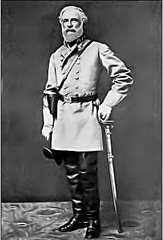
But the North won the war, and in doing so, was able to show dominance and write history. The North began winning many votes by the emotional argument used on the slaves. The North with the help of the Central Government, made the South submit to many of their ways. Reconstruction was not just cleaning up the economy after the war, but reconstructing the South. Much terror against the South still continued. Robert E. Lee himself said that if he knew that the South would have been treated the way they were after the war, he would not have surrendered, but would have fought to the last man.

I do not attempt to claim perfection to the South. They probably should not have seceded, at least not at the time that they did. Slavery, except for rare exceptions, is wrong, and contradicts the founders view of natural law and natural rights. There were good people in the North, and good people who fought for the North, and some people in the South with bad intent. But there were many things that the South stood for that were good, and many things that the North stood for and did that were absolutely immoral. In the least, I hope this provides balance to a largely unbalanced issue.

But don't just take my word. Here are some interesting links:

http://youtube.com/watch?v=x0nCil3D1ZU

http://www.historycooperative.org/journals/jala/14.2/vorenberg.html

http://quotes.liberty-tree.ca/quote_blog/Abraham.Lincoln.Quote.C318

http://www.geocities.com/mark_willey/civlwar.html?200720

Monday, December 17, 2007

Lessons in American History, Part I: The Growth of the American Government

The Growth of the American Government

Written for December 14, 2007

Ryan Hampton

The American Government has grown emmensly from its original intentions. The early American way of free choice, a strong defense, the right to bear arms, a free market, etc., has been replaced by government programs and government laws that destroy the dignity of this nation. Perhaps the worst part of this is that it comes from the Federal Government – not state governments. The Federal Government has forgotten its Constitutional purpose and has in effect deteriorated what should be the American way – and the people do not even realize it.

The early American government worked generally according to plan. There were not many government programs to help different people, nor were there many government laws taking away free choice. The government had its problems but the general tone of the early years of American government was good and Constitutional. But somehow this good government has deteriorated. When did the American government begin to deteriorate? When did the government grow past its Constitutional authority?

Most historians at some level or another, credit the War Between the States as the growth or changing point for American government. These United States became known as The United States. The Federal, or perhaps better put, Central Government, was no longer a covenantal body of government to protect the rights of the states and the people therein, and provide a strong national defense. It was now a massive body of government used to take away states right’s, and the rights of the people therein. It became the one government of America for all Americans. It was the supplier of goods and services to Americans. The government took the place of business, trade, and freedom.

What caused this growth of government right here at the War Between the States? The two are related. There were many differences politically, economically, geographically, etc., between the North and the South, which led to much conflict. The Central Government then became the government to “fix” these problems. They did so through aggression, and disproportionate tariffs against the South. An unnecessary war was raged against the seceded South. Lincoln, then President, set the tone for big government, and it has not let up since.

After the War Between the States, the Central Government continued to increase its power. “Reconstruction” was a government force against the citizens to make the nation the way the government wanted it. Free choice was limited. The South was no longer a section of the nation with its own ways, values, and pride. It was a section for the Central Government to oppress.

As time wore on, the government continued to expand its jurisdiction. In ten years, roughly from 1859-1869, the government had grown substantially. The government started having more and more control over schools. Eventually the Central Government created a government controlled monopoly in the school system. The government continued on its path of big government leading into the twentieth century. Early in the twentieth century, more political turmoil turned the government to grow even more, and it has not let up since.

In the early twentieth century, women started complaining about their lack of rights. In theory, their fight was just. They wanted their liberty to vote and carry out their rights as citizens. But this was yet part of the political turmoil of the day. Women used much rhetoric similar to feminists today, and turned to the government for help. Regulations in what would otherwise be free trade were mandated by the government due to the fuss of women and minorities. Many other social movements came into play, such as the “social gospel,” a movement which suggested that the medium to success and a Godly environment was through government – even the Central Government. The idea of a social gospel without the government is good. This spawns new technology, new ideas, freedom, etc. But a government trying to force this gospel is dangerous.

In 1913, the government amended the Constitution to collect income taxes. Ever since this time, income taxes has been driven off the wall. Originally the founders were against income taxes. Now, the government seeks to collect them, and the income taxes are consistently growing.

Also in 1913 the Central Government passed a law regulating shooting migratory birds. The general idea to protect wildlife is good, but this kind of law is permitted no where in the Constitution.

Also in the year of 1913, the seventeenth amendment came to the United States Constitution. This amendment changed the election of the Senators to a direct vote from the people. This again sounds good on the surface, but it distracts us from the mixed government concept our founders envisioned.

Finally in 1913, President Woodrow Wilson created the Federal Reserve. This again is an example of unconstitutional, monstrous Central Government. However few people then, much less today, recognize this.

Prohibition came about in the 1920’s. This outlawed the consumption and buying of alcohol. This may seem like a good idea, but it is just another example of government growth. No where does the Constitution permit the government to do such a thing, nor at any place hint around at it to give any just notion to amend the Constitution on the matter. Prohibition led to more crime, and most people even today believe it was a bad use of government.

After these events, it seemed as if the economy was booming. The 1920’s are actually
known as the “roaring 20’s.” The economy was filled with money and many more government – seemingly at the price of no one. But this would not last. It seemed too good to be true. It was. The Great Depression hit in 1929.

It is interesting to consider that the Great Depression hit right after an economic “boom.” This economic “boom” came soon after the creation of the Federal Reserve. This points us to the danger of fiat money. Fiat money is government controlled money, and is unconstitutional.

During the Great Depression, President Franklin Roosevelt advanced the size of government all the more. He created many laws and regulations on the economy. He created social security – something once again that is unconstitutional. He sponsored the Agricultural Adjustment Act, which limited agricultural supplies! This is a silly, childish, and unconstitutional attempt to help the economy. Roosevelt is sometimes considered the President who drove America out of the depression. However he is actually a major reason it was prolonged.

In the 1940’s America became engaged in World War II. Previously, America had not been engaged in much international conflict. But since the two World War’s, especially the second one, America has been engaged in many foreign affairs – even those that are not of a direct threat to the homeland security and peace of the nation. This again is government growth.

In 1964, any hope of possibly returning to the gold standard seemed abolished. Quarters, once made of real silver, were now no longer made of silver. The real value of the quarter then decreased.

The government increased its growth by creating programs of exploration, such as exploration into space. It is a good thing to study space, but it is dangerous to do so at the Central Government level. Free markets always work better than government control.

But the government did not stop there either. The government acted unconstitutional judicially. The philosophy of John Marshall was obsolete in the minds of many judges. Many cases that the United States Supreme Court had no jurisdiction in in the first place, were ruled by the Supreme Court in perhaps the worst way possible. In 1962 the Supreme Court ruled that government schools could not permit prayer. The government, especially the Central Government, has no Constitutional authority in education in the first place. They made this worse by controlling it.

In 1973, the United States Supreme Court overturned any federal or state laws regarding abortion. Abortion was deemed by the Central Government as a natural right. Now, not even states had the authority to pass their own laws on the issue. This ruling increased the Central Government by taking away states right’s.
The United States meanwhile was engaged in all sorts of foreign affairs, some of which are not even resolved today. The government continued to grow in all these ways. In the 1990’s, government spending grew all the more. The minimum wage was increased. More and more programs for the poor and minors were established. More foreign aid was given. Government has grown all the more even in this decade as well. The Federal Debt is higher than it has ever been, and it keeps increasing. More government programs have been in place as well. In 2001, President George W. Bush issued the No Child Left Behind Act. Just after the tragic events of September 11, 2001, he issued the Patriot Act.

America has forgotten its purpose and ways of free choice, free trade, and a federal system of government. The Constitution is now seen as a way to limit the rights of the people, not the rights of the Central Government as it was supposed to. The few things that the government is supposed to do seem to be the things ignored most by politicians. Namely, these would be the protecting of our rights, state’s rights, and securing the peace at home. Only time will tell if America reverses this trend and gets back to the way its founders wanted it to be. But as for now, the Constitution is a forgotten document, and a limited government is a nearly forgotten concept.

What do you think?

God bless America

Pray for our Troops

December 17, 2007

Ryan Hampton

Sunday, November 18, 2007

America's Beginning Government

The following was a paper I wrote for school. It is about the early years of American government, and whether or not the early government worked.

America’s Beginning Government
Ryan Hampton

Did America’s Constitution work? Did the American Government operate according to plan? Did the American Government operate in a way similar to or worse than the government it got away from? These are some questions that we ponder in studying the early years of America’s history. Could it be that America fought a war, lost many lives and a lot of money, only to live in a worse condition than before? Or was their fight for liberty just, upheld, and worth it?

So often in a Revolution, the new government is quickly even worse than the government thrown off. In a revolution, there are many chances to take. Was the government worth throwing off? Are the people who are throwing off such government better people anyway? Perhaps they are just power hungry themselves. Perhaps the causes for this liberty were just and well meant, but the new people who came into office wind up falling into the temptations of power.

Thomas Jefferson, America’s third President, pondered on these issues himself. He said that it is the natural tendency of things, especially government, to gain power. More and more actions become justified, and people become polarized to the extremes of big government. In governments, the government seeks to expand its jurisdiction, justify more of their actions, and ask for more money to fun these actions. Thomas Jefferson, and many of the others who recognized and feared these things, sought after a government that would last a long time under its conditions, without falling into these problems. The government they proposed promoted small government.

We are now nearly two and a half centuries after the American Revolution, and Jefferson seems right. But what about the early years? Even if the American Government today seems much like the British Government that the founders sought to either reform, abolish, or separate themselves from, perhaps the Revolution was still worth it based on the initial years. Were America’s early years good, or was it a quick strike to typical ways of the government America’s founders got away from?
When we explore the early years of the American government and whether or not it worked, we should ask two questions. First, we should ask ourselves if the government lived up to its purpose and theory, or if the founders defeated their purpose? There were some documents that the American founders drafted that did not seem to work to them, i.e. the Articles of Confederation. But the American founders properly cut off the wrong parts of this bad form of government, and sought after a better government that would stay – the Constitution. Did our founders draft a Constitution, speak so highly of it, only to forget about it? Or did they take their verbal word and written word to heart, and abide by the Constitution? The answer seems to be a resounding yes. There is no question that our founders made mistakes, but as a whole, they did abide by their word. But now we must ask the second question: was this form of government good and worth abiding by? For the dominance of America’s early years, it seems as if the Constitution worked well. The people abided by it, and it kept the government in check. The government stayed out of debt and out of trouble. The American people were free. The economy began booming, and America never in her early years experienced a depression due to inflation and fiat money – although they did exist to a degree. The Constitution worked. Therefore, unlike many Revolutions, America’s Revolution actually did make a better government. The founders of America proposed a Constitution that would in writing, limit the government to its just powers. The American founders initiated checks and balances to government. The people and founders gave much thought, fear, and study to different ideas about government, ranging from the Judeo-Christian thought to the thought of the great Greek philosophers. To support this claim that the American government originally worked well, let’s consider the facts and historical events that attest to this.

But beyond this, the many of the early leaders were fearful of God. One reason many newly established governments become worse than the abolished government, is because the people put so much trust into one of the heroes, that he can essentially become a monarch. When a leader gives into the temptation of power, he and his office are corrupted.

But such was not the case in the early years of American Government. George Washington was given an opportunity to become sole leader. The American people loved him. They would have been willing to give him full control. But Washington set the precedent. He took office, followed the Constitution, and took advice from his advisors and fellow politicians. After this, he only served two terms. He could have served longer. Everyone loved him. But he said that his time was up after two terms. He set the precedent. It would have been much harder for future Presidents to take full monarchial power.

One example of the early American way sticking to the Constitution is seen in the case of Marbury vs. Madison. George Washington shaped the role of the executive branch of government, but in this case, John Marshall set the tone for the judicial branch of government. William Marbury rightfully had the right to hold an office as a judge, but John Madison never gave him his commission as Justice of the Peace. Marbury instinctively turned to the Supreme Court. But Chief Justice John Marshall would not rule on the case one way or the other. He did believe that Marbury had the right to the office. However he also that that Marbury had turned to the wrong place. Rightly or wrongly, the Constitution did not permit jurisdiction to the Supreme Court to rule in such a case. Therefore, he did not rule in this case, setting the tone to view the Constitution as a “higher law.”

Another important figure in the early years of American government is Thomas Jefferson. Thomas Jefferson was for very limited and small government. However when he came into office as President, he wanted to do more things than he previously let on to, such as building schools, roads, and the like. But Thomas Jefferson did provide a higher view of the Constitution even in this. Although he may have wanted more things to be done with the Central Government when he became President, he only would allow such things done by an amending the Constitution. Because the Constitution was not amended to his desires, his desires did not come – at least not under his term in office.

Most of the founding fathers of America talked about small government and natural law and lived up to their rhetoric in office. Not many of the early founders pushed for an extremely intrusive Central Government. Not many founders pushed for overbearing taxes. Most of the founders placed a high regard to the Constitution. The American debt was low, and most of the people lived in peace. America was not constantly engaging in international affairs. Most of the founders practiced what they preached.

It is important to remember, however, that the government did have its problems. Fiat money came quickly. The government began to get involved in building and manufacturing things. The government was not perfect. There were political rivals. There was controversy. There were some people who pushed for some policies very much like mercantilism – a method of government our founders wanted to get rid of. Some people falsely justified government action by the Constitution. But even beyond all of this, the government worked fairly well under the early years of its Constitution. The founders never expected a perfect government. They realized that government is comprised of sinful people. This is why government is held in check. And the checks and balances fit well in the American system of government. The founders were morally minded enough to keep themselves from totally abusing power. The Constitution was written well enough to clearly define what roles the Central Government had. Despite some of the early problems, government worked reasonably well in the early years.

Perhaps the biggest controversy the early government faced was in interpreting the Constitution. Most all of the founders agreed to follow the Constitution, and did so as it fit to their terms. But some people viewed the Constitution very strictly, while others viewed it very loosely. Perhaps the most debatable phrase used in the Constitution was the “general welfare” clause. Some saw promoting the general welfare as meaning to provide government action to help the majority of people- a rather democratic idea. Others viewed it as a clause that meant for the government to show support for whatever would help everyone at the expense of no one. When one takes a straight-forward approach to looking at the Constitution, it seems as if there is no good evidence that “general welfare” could mean a general government program to help the to general mob. It rather seems most like the second of the views above – to promote that which helps everyone fairly at the expense of no one.

The early American government did embrace a small government and drafted their thoughts in the Constitution. Not everyone had the exact same beliefs on interpreting the Constitution, but as a whole, it seemed to work. And there is no reason to think that the Constitution will not work today, if we let it. The problem with America’s government today is not that we abide by a false Constitution, but that we forget about it. If we return to the basic policies held by our founders, there is no reason to think that we should see anything but an incline in sound government.

What do you think?

God bless America

God bless our troops

November 18, 2007

Ryan Hampton

Wednesday, October 31, 2007

Happy Halloween

Today is Halloween. It is the day we carve pumpkins, trick-or-treat, tell ghost stories, or perhaps, complain about the 'satanic' influence of this day. Some consider it a holiday. Some consider nothing at all. Some call it the Devil's holiday. Some people refuse to recognize it or do anything for it.

What many people do not realize is the history behind it. Originally, according to many historian scholars, it began with the Celts in Ireland. They celebrated their New Year on November 1st. This was the end of summer, and the beginning of winter according to their tradition. This would damage crops, making it harder to survive. The night before this was thought to be the night when the souls of the living and of the dead blurred together.

But while this is all scary-sounding, and much like the modern-day view of Halloween, the actual real history of Halloween is largely Christian. As time went on, Christianity spread into the Celtic area. No more were the major fears of the dead becoming living. Now, a Christian influence had spread, and it was time to end this non-Christian view Halloween (then called Samhain). Pope Boniface IV designated November 1st as All Saints Day. October 31st was All Hallows Eve (Hallows meaning 'Hallowed one's' or 'Saints'), and eventually, Halloween (note the similarities in names).

From here it history is disputed. Some blame the Christians for jealously taking over a secular holiday. According to these people, Pope Boniface IV was responsible for this. Others say that there was no relation at all between Halloween and Samhain, and the Samhain tradition simply followed over into the eve of the Christian holiday, All Saints Day. Some consider the Pope was intentionally replacing the older Celtic tradition, but was justifiable in doing so. According to these people, Christianity spread, so the once secular and somewhat satanic holiday should be Christianized. Dressing up as "scary" creatures may symbolize either Christians scaring the deamons of Satan, the Christians mocking Satan, or could symbolize the Christians lack of fear for Satan and his demons. It is really up for debate and question, and up to the individual family how they see it.

But whether or not you celebrate Halloween, perhaps you can celebrate Reformation Day. All Saints Day and the Irish/Celtic tradition of Samhain all came before Reformation Day. But it is fitting that Reformation Day be celebrated at the time we do honor all of our Saints.

On October 31, 1517, Martin Luther (seen on left) nailed his ninety-five thesis on the church door at Wittenburg (or perhaps mailed them, but the traditional thought is that he nailed them). This sparked the Reformation. Most churches celebrate Reformation Day the last Sunday of October, but the historical date of it is October 31st.

Though this was the Protestant Reformation, perhaps Roman Catholics can celebrate this as well. The univeral church has never been perfect, but God is always giving it Reform. Sometimes the reform stands out, and other times it does not. Martin Luther was not a perfect man, nor were any of the one's who followed after him, such as John Calvin, Ulrich Zwingli, Martin Brucer, etc. But these were all men who pledged their faith in Jesus Christ, and made their stand on God's Word. May we always, of any denomination, pledge our lives to God, and look to bring reform to the church and to the world.


John Calvin, seen to the left.


So however you celebrate this day, or if you do not at all, my wish is that it is done in fear of the Lord. If you celebrate Halloween, then may you celebrate it in light of the Gospel. May you look to God, and be thankful for all the Saints who have pledged their lives and Sacred honor to God. May we do the same today.

For a couple of interesting articles, see these:

http://www.history.com/minisite.do?content_type=Minisite_Generic&content_type_id=713

http://www.biblicalhorizons.com/open-book/no-28-concerning-halloween/


"Hier stehe ich; ich kann nicht anders. Gott helfe mir! Amen. [Here I stand, I can do no other, God help me.]" -Martin Luther, Diet of Worms. When asked if he would recant, he gave his famous, "Here I Stand" speech, saying that he would not recant, unless convinced by "God's Word and pure reason."


What do you think?

God bless the church

God bless America

Pray for our Troops

October 31, 2007

Ryan Hampton

Sunday, October 21, 2007

A Tribute To Lynyrd Skynyrd

This is also seen on the Reckless Abandon music page. Reckless Abandon is the band I am in. [See Links].

Yesterday marked the 30th anniversary since the plain crash killing several of the members of Lynyrd Skynyrd. In this crash, lead singer Ronnie Van Zant, guitarist Steve Gaines, his sister and backup singer Cassie Gaines, another backup singer with the group, and a tour manager, were all killed in this plane crash. In my opinion, Lynyrd Skynyrd, as a music group, is one of the greatest of all time in Rock-N-Roll history. Lynyrd Skynyrd mixed rock, country, and blues together to make a real but semi-twangy southern rock. Their song Freebird has rivaled Led Zeplin's song "Stairway to Heaven" as the most requested songs on FM radio. If you are pickin' away at the guitar at a local party, you should never be surprised someone in the audience to yell "Freebird!!" or another of their great songs. In fact, just yesterday at Reckless Abandon's first gig, there were three of their songs played, of course, Freebird being "requested."

But their fame was well deserved. Their fame proved not to be a fad. They played music relative to the working American - which is who they were. I personally consider the great late Ronnie Van Zant (original singer of Lynyrd Skynyrd), as one of my lyrical inspirations. The songs were relative to true stories. "Gimmie Three Steps" was inspired from a true story. "The Ballad of Curtis Leow" was actually inspired from a group of great blues singer. "Freebird" was used as a metaphor for the groups outlook to much of life. Only Ronnie Van Zant wrote of the haunting question, "If I leave here tomorow, would you still remember me?" Lynyrd Skynyrd is perhaps the only rock band in history who through the lyrics of Ronnie Van Zant, would write a song as a tribute to their mother. They did this through their song "Simpleman" which shows a dialogue between Van Zant's mother and Van Zant, with his mother doing all the talking through her precious wisdom. Only Ronnie Van Zant showed through poetic romantic literature his utopian view, but realism of the "concrede slowly creeping" into his Southern and traditional home. In this song, "All I Can Do (is write about it)," Van Zant says he can't make changes, but can only write his experiences is a song. This has got to only show Van Zant's pride in the band and its music.

But it was also the sound of the band that drew long-term attention as well. The band mixed Southern country with blues and a driving rock. The guitar solo's for "Freebird" and Simpleman" were almost as good as the powerful lyrics for the songs. The powerful duo of Allan Collins and Gary Rossington was simply amazing. Lynyrd Skynyrd is the holder of what is perhaps the greatest Southern Rock song of all time, "Sweet Home Alabama."

Perhaps many musicians of today can learn from the great Lynyrd Skynyrd. Not many musicians or bands have the same powerful lyrics and powerful music as was found in Lynyrd Skynyrd. Since the plane crash they have just not been the same. But the apparent answer to the haunting question "If I leave here tomorow, would you still remember me," appears to be an obvious yes.

Rest in peace.


Thursday, October 18, 2007

The Forgotton Purpose of America's Constitution

This is a paper I wrote for a school class (Government and Economics) concerning the purpose of a Constitutional Government in America.

Why a Constitutional Government?

Perhaps the most important, but yet most overlooked document in America today, is the Constitution. Many government officials take an oath on the very Bible to uphold the Constitution, only to break it severely. But it is the Americans that elect these people into office, only to believe lies not permitted by the Constitution. How could both every-day Americans and our leaders be so blind? And what is the purpose of a Constitutional government, anyway?

There are many angles one could take as to why we have a Constitutional form of government. But it is probably best to begin by having a basic understanding of what government is. First, both the idea of government and the idea of limited government are theistic ideas. We have government to secure the self-evident rights we have, most commonly referred to as life, liberty, property, and the pursuit of happiness. These rights are self-evident and logical. However to an atheist, there is no ground to justify morality on pure logic. Therefore, having a government to use force against citizens using force to damage the self-evident rights of others is only consistent in a theistic worldview.

However the very idea of a limited government is also theistic. In an atheistic worldview, the only purpose of government would be for it to become their "God." The government would then become the moral police of the world, and essentially become communistic in the economy. But the people who comprise the government are sinful people, and it would be dangerous to give them too much power. The idea of a limited but yet strong government gives rise to people living their own lives, pursuing their own dreams, having their own religious beliefs- all without taking away these rights of other people. This is made so clear in the Declaration of Independence, in saying, "We hold these truths to be self-evident, that all men are created equal, and that they are endowed by their creator with certain unalienable rights, that among these are life, liberty, and the pursuit of happiness. That to secure these rights, government are instituted amongst men…"

The essential purpose of government is to guard the land in which it governs, and protect the rights of its inhabitants. The government should be strong, and the government should be limited. Essentially, government is force. This is essentially what governments exist for. However there is some variation of different bodies of government relative to the time, the government jurisdiction, and related bodies of government near it. There is not one absolute "method," to anything that government is, should do, or should not do. Therefore, it becomes essential to look at the United States today and in the day it was founded, as to why it holds a written Constitution.

The government of the United States is complex and sophisticated. The government was founded by the common causes of the colonies who were dissolving their allegiances to the British government. Originally, all colonies were very skeptical of having any sort of general government around them. However each colony wanted to be stronger in itself. For this reason, the colonies compromised some of its powers to a central government. The founders wanted to make this government a government that would make the colonies stronger, but also keep as much power in the colonies as possible. Before drafting the Constitution, the founders originally drafted the Articles of Confederation.

The founders created a sort of mixed government. It is hard to use just one word or phrase to describe the government in America. Contrary to popular belief, America is not a Democracy, although there are some democratic principles that make up what American government is. But if there is one phrase to describe American government after the drafting of the Constitution, it would be as a constitutional federated republic. To study why the term "Constitutional" is used, we should first study the term republic, moving our way to "Constitutional."

A Republic is a government whose general power rests in the hands of the people, but whose people elect officials and representatives in order to enforce laws and secure the peace. This is basic American government. But American government is still unique. As noted above, America is a mixed government. But not just that, America is a federal system of government. What does this mean?

The American government is composed of a Federal, or perhaps better put, "Central" Government. But within this central government, there are several states with their governments exercised through a similar method of mixed government. There was a federal, or "covenantal" relationship between the state governments and the central government. The states give up a portion of their just powers to the central government for national defense, common trade, and the like. However the central government was limited perhaps more than the states. Knowing exactly where to draw the lines for the duty of the central government as opposed to the state governments was hard. What would the founders do now in order to secure this order?

This is where they envisioned a Constitution. A written word and document does better than mere ideas. Not just this, but they were inspired by the Judeo-Christian idea of a written word- as is done with the Bible- as well as the many documents in their colonial history. The American founders believed strongly in holding to a binding agreement- especially if it is written. Now the leaders can take oath not just to mere flexible ideas, but to a written word.

The Constitution was written as a binding agreement on apart of the states in the Union, and the Central Government over the states. At the time, there had been argument as to the superiority, or lack thereof, of government and the people. Furthermore, there was argument as to what level of government- the states or the Central Government- was superior to each other. Some people believed that the Central Government was, or at least should be, the dominant and superior government over the states and the people. Others believed that the states were superior to the people of their respective states, and to the Central Government. Others believed that the people were the overall and superior power and that governments exist only to secure this superiority. The Constitution used all of these ideas to explain what rights each level of government has. The people are sovereign to their own wills as long as they do not offend the sovereign rights of others. Yet the people must submit to governmental authority. But the Constitution went further by designating who has the rights to pass and enforce laws regarding what constitutes as offending the sovereign rights of others. If a law should be passed, who should pass the law? Is it the states or the Central Government?

Once again, the Constitution answered these questions in written form. The founders also formed three branches of government: the judicial branch, the legislative branch, and the executive branch. There was still common law, that is, unwritten law. But this must show sovereignty to statutory law, or written law. The chief and sovereign form of this statutory law is the Constitution.

Moreover, the Constitution gave defined improvement in the nation’s government from the Articles of Confederation. A Confederation often seems to either fall apart in time, or be dominated by the largest state. The Constitution was more than just different bodies of government working for some common cause. The Constitution gave this cause a general government, and in written word would resolve any conflict left by an unstable Confederation. The Constitution did not give this general government a lot more power than it could have vested from the Articles of Confederation, but it did establish real stability that the Articles of Confederation did not. Most of the people who were for the Constitution did fear the government, particularly the Central Government, gaining too much power. Therefore, it would be unreasonable to suppose that the founders did not heavily ponder on the roles of each government and just immaturely and hastily draft a Constitution. The thought and fear that went into the drafters of the Constitution is missing in many politicians in America today.

This was the reasoning that went into the drafting of the Constitution. Essentially, a written document was something the founders had much respect for. It was seen in the Bible, and in many documents drafted by the colonies before the American Revolution. What better way to secure the rights of people than to have a written word that, in much detail, prescribes the roles of government, limiting them to essentially defending the rights of the people? Thomas Jefferson said that the natural tendency in government is for a government to gain power. He was right, as is evident in comparing America today with the America at the time of the founders. But the problem with the political America today is perhaps not that we have a
Constitution, but that our leaders forget about it.

What do you think?

God bless America

Support our Troops

October 18, 2007

Ryan Hampton